Since these projectors were released, I have been, sort of, in love with them.
What am I talking about?
Fujifilm Z-series.
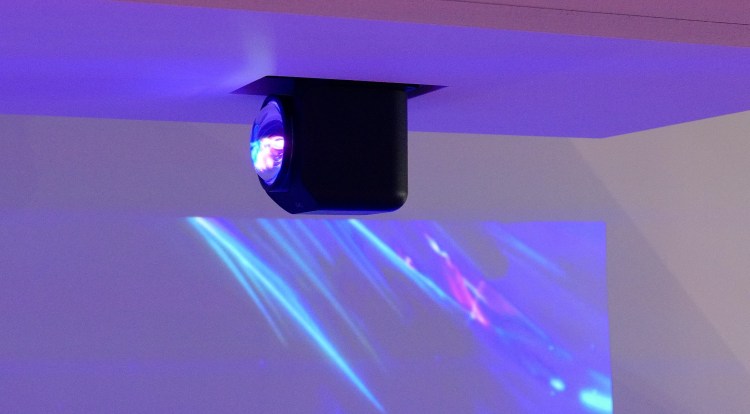
He is a bit shy. Hiding within the ceiling.
Unfortunately the initial Z5000 had some short comings. Optically a fantastic projector with the ingenious rotating lens in a compact package.
But as with all new developments, some things the engineers thought about were not as good as expected and one benefit of the projector, its ability to be installed close to the ground and still project halfway up the wall, was also one of its handicap, due to the vacuum cleaner effect.
At 5000 lumens, many regarded the projector a bit too expensive.
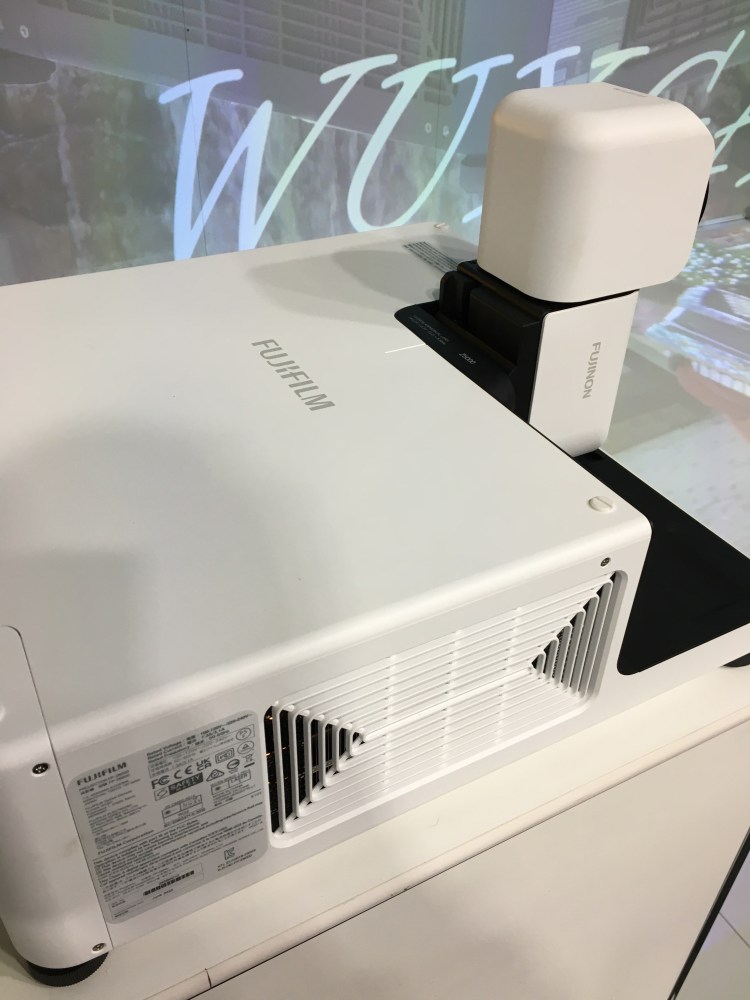
But then came the Z6000 and with it also the Z8000. These designs overcame all the issues of the Z5000 and performing as well or even better.
Even simple issues were addressed, such as the inclusion of grip inserts to make transport easier, where the 5000 would slip out of your hands.
But more were the improvements in the area of application. Improved HDbaseT, SDI inputs, lens movement/ rotation without the need to turn the projector on, a much advanced adjustment and colour management menu, which allows the projector to be used in medical as in broadcast applications.
The 6000/ 8000 stated lumens were in fact true lumens, not degraded by interchangeable lenses or mirrors.
The ultra short throw lens, which gives me wall covering projection from the edge of my desk, plus the fantastic shift capability.
I love the latter one, because I do not have to plan meticulously where to place the projector. In almost all cases, I just use the shift, combined with the keystone adjustment to get the projected image where I want it. Extremely helpful if you have obstructions, like columns in the way.
The zero-offset projection allows me to position the unit to the edge of the screen and not wasting valuable or non-existent ceiling space. This in particular since many smaller rooms have a limited ceiling height.
Of course WUXGA capability a must nowadays.
As you can expectt, at times the projector may have to sit at odd angles toward the screen or the surface is slightly curved. Many projectors would throw their arms, if they had, up and say, sorry mate, but either the centre or the edge sharp, but not both.
The Z-series has double focus action, allowing the centre and edge to be focussed separately.

Z-Series projector in immersive application.
Sure the projectors are not lightweight as such, but compared to other, as sturdy manufactured units, they are portable enough for a single person, any gender to handle.
Price?
Usually you expect that new models either have reduced features for the same price or an increased price. Not the 6000. You can still buy it for the Z5000 price.
What about the Z8000.
Well one can argue that this one is a bit at the upper limit. But considering build-in blending and the medical critical DICOM performance, the projector is worth the asking price. Plus, I am sure, Fujifilm is happy to talk price, if you look at buying more than one unit.
Talking price. Did you know that delivery is always included.
Taking all these factors into account, I am wondering why not everyone has at least one of these projectors. Not only for the office, training, meetings, conferences, performances, etc.., but also at home?
Maybe in the latter case a 4K capability is what the punters ask for. With that, even the smallest (modern apartment) would allow wall filling projection without having to break the wall down.
Fujifilm Z-Series projectors are available through ITI-Image Group, Sydney.
Just e-mail: itiav.support@iti-imagegroup.com.au for your price.
Discover more from ITI-Image Group, Sydney
Subscribe to get the latest posts sent to your email.
