Curved and shaped projection screens are essential for immersive projection environments, simulation and special impact shows.Curved screens may just be slightly bend or created up to 360 degrees. Most applications would have screens in the range of 180 to 270 degrees.
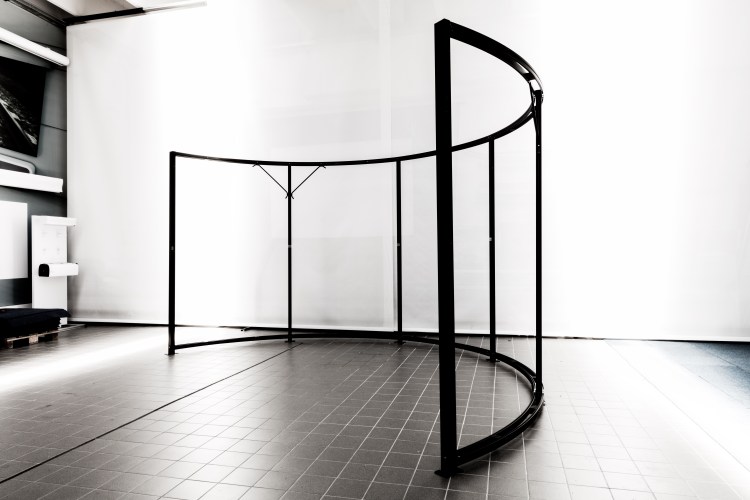
At ITI we are working with two manufacturer. Screenline from Italy and MOCOM from Korea.
Each manufacturer goes different ways about solving the challenges.
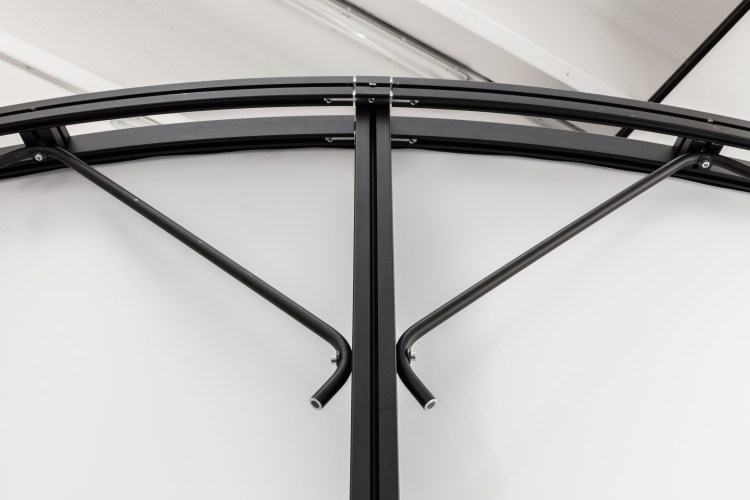
Screenline screens use a double rail aluminium profile which provides a great stability and has virtually no bending tendencies. The screens are made of separate segments, which are locked together on site. This makes transport to and assembly in tight spaces easy.
The aluminium is black anodised to prevent reflections and the profile type allows the attachment of digital prints at the rear to prevent the structure to be visible.
Screenline offers both solutions, with and without border.
The projection surface usually consist of a stiff PVC material which is attached on slidable anchors to the front of the structure. The sliding anchors have the advantage of easy elimination of creases. To reduce the ‘belly’ effect of the PVC in curved set-up’s, the bottom bar can be tensioned. However at very tight radius, the tendency of the PVC to pull forward can not be eliminated.
We usually offer Screenline for curved screens or immersive designs.
Screenline is ideal for touring shows and regular set-up and pull down.
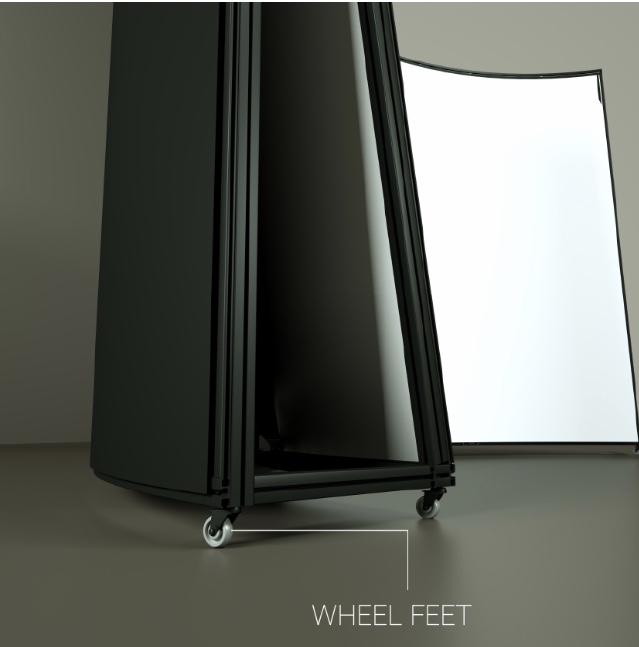
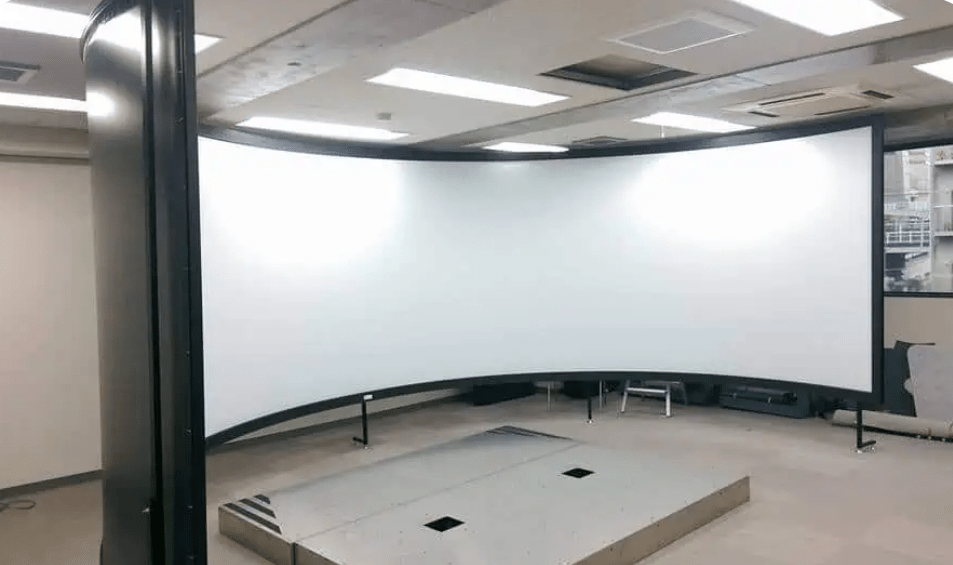
Image from MOCOM Website
MOCOM uses a different approach. The frame consist of a aluminium profile which is about 1 cm thick and has a sloped edge. This profile can be easily bent and shaped. However it has not the same strength as Screenline. For that reason steel support structures are being used to maintain the vertical spacing between the base circle and the top circle.
This structure allows easier integration of entry doors for enclosed screens.

The set-up of the frame structure this similar to that of Screenline, though more separate components need to be assembled. Due to the lower profile strength more personnel is required for set-up, to avoid inadvertent bending of the profile.
The projection surface is attached at the back of the profile, using small springs. This is more time consuming, so therefore this screen is more suited for permanent installations.
Once the screen is pre-assembled, all parts will be anodised. The screen design does not allow the manufacturing of borderless screens at this stage.
The surface material is a stiff, woven fibreglass with white coating. This stiffness prevent the ‘belly’ effect and the surface is perfectly flat.
As can be seen each design has its pro-and-cons.
MOCOM is able to make very large screens and recently made an oval shaped screen with 8m length for us.
.
Discover more from ITI-Image Group, Sydney
Subscribe to get the latest posts sent to your email.
