Shaped projection screens are becoming increasingly popular. This is aided by adjustment and warping technologies with are either build in to the projectors or provided by external systems, just as VIOSO, Geobox, etc..
The relatively smaller chip size of the projectors, compared with systems in the past, and corresponding increase in depth of focus, makes ist much easier to project with even a single projector over several planes in relative sharpness.
What falls under shaped projection screens?
The most basic shaped screen is projection on to a wall, building, rockface or object, like a car. While most of these surfaces have a comparatively flat surface, some, like the Sydney Opera House or a car model represent a more challenging environment.
Of course with a longer viewing distance, as in case with the Opera House, slight de-focussing in some areas is less perceived by the viewer, but could cause significant issues when it comes to blending several projectors. But that is a different story.
The use of shaped projection surfaces is very common. Just visit one of the many museums, art centers or other public displays. In many case a specific projection screen is being used.
One of the critical aspects of using projection screens is maintaining consistency in the plane of the surface. If you were to use a screen made of thin plywood, supported by a strong structure, you could expect that the surface area will be reasonably flat.
This flat surface would guarantee that straight lines or geometrical figures will be projected without distortions.
However plywood needs to be treated, undercoated, painted. The mounting nails need to be covered. All up a very time consuming process and subsequently expensive. Projection paint which retains colour accuracity and brilliance together with a good contrast ratio, while available, is not cheap either, in particular if next to the undercoat which prevent the paint being absorbed by the timber, may require up to two coats for an even coverage.
This brings us to screens which use either a PVC, Fabric or Fiberglass based surface.
I am thinking here about brands like Screenline, MOCOM, Stumpfl, etc..
These systems using a separate aluminium + steel frame on to which the surface is attached.
PVC surfaces are very commonly used, since they can be stretched for attachment, but folded for transport. However PVC surfaces, when stretched, tend to bulge forward from within the screen circle of a curved screen. This creates issues with focus, but more with a correct geometric display of lines. While a camera based image correction system can ensure that the projection looks perfect from a front view, from the side, the eye can perceive the ‘bulge or belly’. So we are trading convenience with correct reproduction.
PVC surfaces do have another advantage in so far that they can be stretched over the frame and make it easy to create borderless projection environments.
Fabric based surfaces, in particular the pure black, like Sceen Noir, will suffer less from bulge, but to retain a perfectly flat curvature, the surface must remain comparatively loose. It will by its own weight be flat, however any airflow will make it flap. A undesirable effect in projection. If the fabric would be stretched, it will be forced into a straight line, creating the bulge/ belly.
One way to keep both PVC and Fabric flat could be the use of curved steel inserts into pockets at the top and bottom of the surface. This creates a vertical pull whereby the curvature of the rods forces the screen. However issues like flapping may still prevail.
Another good solution is the Fibreglass based surface material as used by MOCOM. This material is very stiff and does not bulge. It can be rolled for transport, though not folded.
Since the material does not stretch, the attachment is more complex, using either springs or a lace out system. This material can be used in curved and flat screens or odd shaped designs.
Of course there are other screen surfaces available. Multi-layered materials which are very solid, aluminium based shapes, etc.. These are more complex and require careful calculations in respect to reflection and viewing angles. Cross reflection, the light from the opposite screen side which spills on to the other surface, have to be carefully controlled. In particular at higher gain materials.
So which screen is ideal for which use?
Plywood – Permanent installations. Cases where the screen becomes part of a fit out or construction.
PVC + Fabrics – Curved screens, odd shape screens, flat screens. The surfaces is attached using press studs, groove lock or other means. This design is highly portable and fast to set up.
Fibreglass – Curved, oval and flat screens in different shapes. Very stable and smooth, but slower to set-up. I deal for permanent or semi permanent installations.
Products available through ITI-Image Group are:
Screenline
Screen NOIR
MOCOM Fiberglass aluminium/steel frames screens.
Sydney 15-1-24
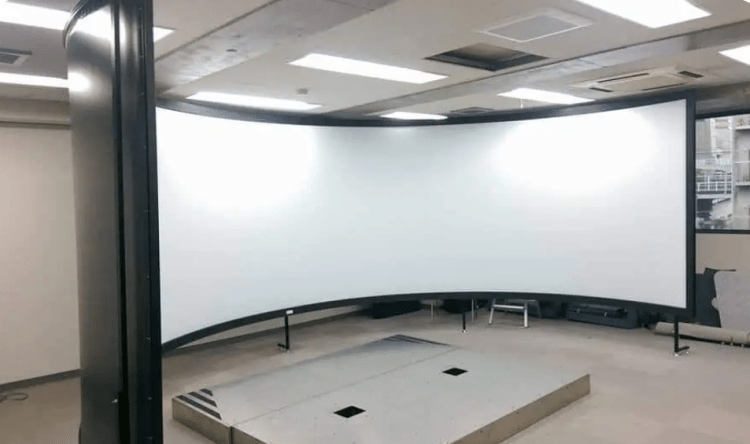
MOCOM Screen
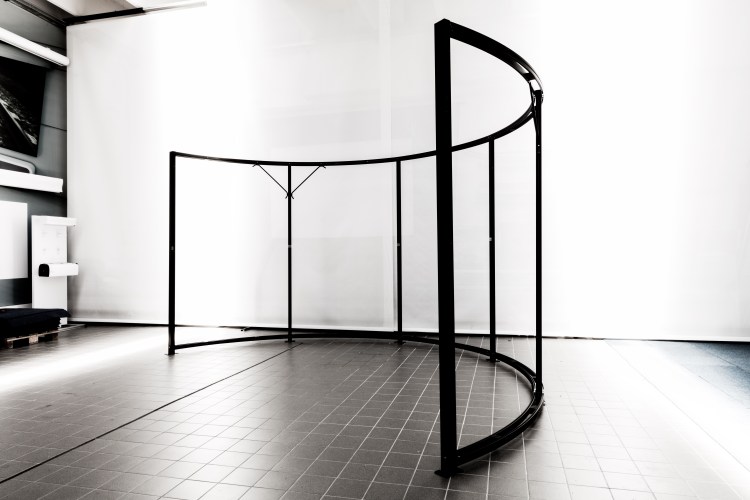
Screenline Arena Curved Frame
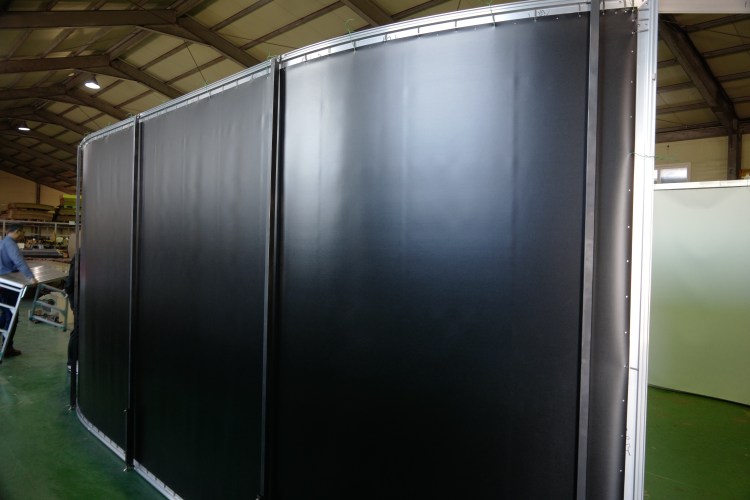
MOCOM Oval Screen
Discover more from ITI-Image Group, Sydney
Subscribe to get the latest posts sent to your email.
