This is a thanks to everyone who was involved and supported the KISTI project, the first, large project for Turnstone & ITI-Image Group, involving VIOSO Anyblend VR&SIM (now VIOSO6 SIM)

Particular thanks to
Hyunjoo Yun, Vizwave, who brought the project to us.
Cho from Vizwave, who spend countless hours on site, far beyond our working hours there, to ensure that everything went smoothly and at the same time learning all he could about the VIOSO product.
Jurgen Krahmann, Vioso. Without his dedication and expertise and in particular good humour, we would not have been able to complete the project.
Julia We, who not only kept everything together, managed the many, sometimes sensitive negotiations before, during and after the project and with but with her charm and smile, and her interpretation skills, kept all working smoothly.

Victoria Schmitz, Vioso, who provided tirelessly, all the factory support and assistance.
And many thanks to everyone, not mentioned here, for their contribution and good spirit, during sometimes difficult project stages.

The KISTI project.
The KISTI project is an important milestone in the co-operation between ITI-Image Group and Turnstone Distribution, since, after many years of promoting the VIOSO Software from Germany, we were finally able to get the technology into an, for the Korean Government, important project.
Throughout the project we learned that the VIOSO product was able to overcome challenges, which we were told, no other product could have solved.
But as always, even the best product can be useless if it were not for the skills and expertise of the operators, in this case, the software engineer Jurgen Krahmann from VIOSO, who flew in, not once, but twice from Germany.

I worked first on this project as far back as 2019 through an enquiry by Hyunjoo Yun from Vizwave, Korea.
Hyunjoo had noted a project by the Fraunhofer Institute, Germany, an upside down dome and asked if VIOSO could do this? To which I confidently with a yes, believing that VIOSO could make it happen, even if they never did before since they had proven this, time and time again, at various projects around the world.

What is KISTI?
KISTI is part of KAIST the Korean Government Research Institute and University in Daejeon, Korea, about 150km south of Seoul.
This is the same location of the supercomputer for research, which makes it a much protected site. This in turn created challenges with electronic access for us from the outside, on-line support and strictly time-controlled access to the site.
A problem at times, since we had to leave the site at 22:00 hours, regardless of the stage of work.
Daejeon is located almost right in the centre of South Korea in a nice valley location surrounded by mountains and plenty of forest. A typical University town with plenty of students milling around and modern government and apartment blocks. During our time in May we were able to enjoy 10 days with plentiful sunshine, while at a repeat visit and training in early August, we had to endure 4 days of 30+ degrees. But of course as always with these projects, most of the time is spend indoors and in the dark.

The KISTI project consist of a 360 degree, 9 meter in diameter circular projection with a floor projection component. The aim is to present VR and interactive presentations in 3D. In addition the facility is to be made available to private corporations for various functions.
For that purpose a Dataton Watchout presentation system was provided, which had to be integrated, so that ’normal’ video and speaker support presentations could be staged.
For the VR and interactive part, the system utilises technology from middleVR and Worldviz.
A total of 13 Barco UMD 4K projectors are installed, together with a media node for each projector consisting of a Dell high end server fitted with NVIDIA CPU’s. Overall a most powerful computer array.

Building the cave
VIOSO Anyblend VR&SIM, now VIOSO 6 SIM, was selected to tie all this together into a seamless blended display, extending from the wall to cover the whole floor. The reason why the VIOSO product was selected is its ability to not only calibrate the required blending and warping, but to provide a convenient re-calibration facility, which can be operated by staff with minimal training. This ensures that an alway perfect projection is presented. Critical for the 3D element and the VR component.
For us challenging was, that no dedicated content had been created at the time we started on the project and even at a re-visit in August only rudimentary material was available.
As often in these projects, the devil is in the detail. While the pictures tell us the story of a perfectly aligned projection in the end, they do not show that, for example, the wall to floor curvature was too tight or that the wedges, which were to provide a continuation of the creature at the door opening, could really not be used, since they were not permanently fitted and made access to the space difficult.

Initially we considered the use of a 5MP LAN camera for the calibration or the use of multiple-cameras.
However, the tight wall-floor curvature did present the limits of the 5MP resolution and multiple cameras could not be used, due to the way how the projectors were rigged.
In fact, if possible, the use of a single camera for automatic-calibration is always preferred, since the number of possible fail points is substantially reduced.
Anyway by good fortune or better to say good foresight, Jurgen had packed a 12MP Camera which had a fine enough resolution to provide enough calibration points for the critical edge.
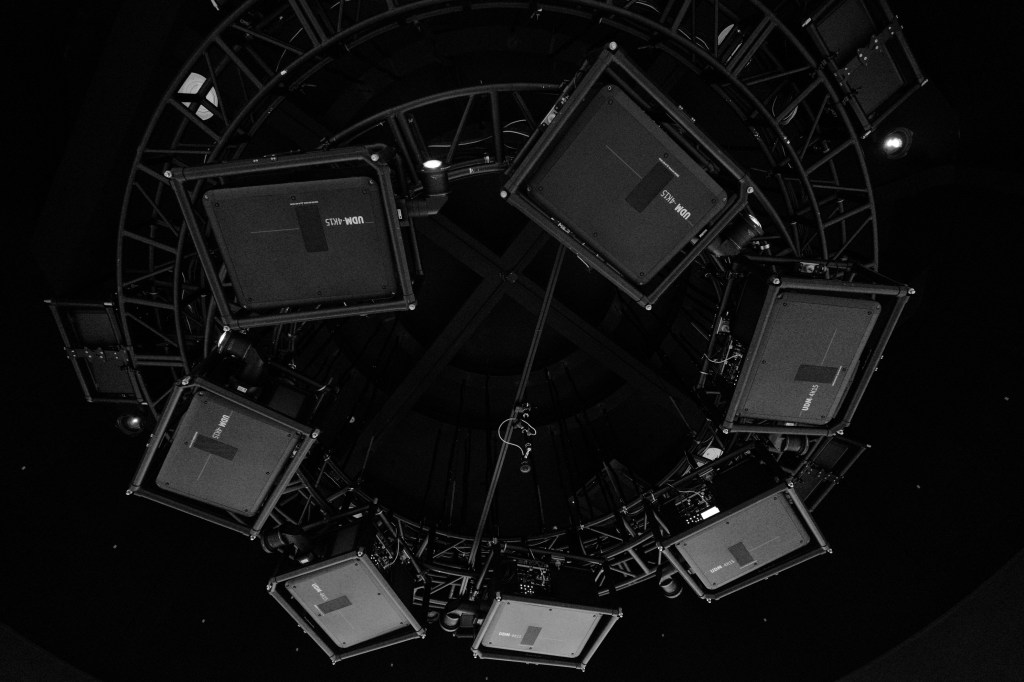
Camera installed
One other challenge was the painting of the wall, which was too light and created issues with cross reflection. In these set-up’s with multiple, high-powered projectors a fine balance must be achieved between image brightness, contrast and reduction of reflected light hitting the opposite projection area.
Subsequently the walls had been repainted slightly darker.
This of course had the effect that the calibration parameters changed and had to be redone. This was achieved, despite the limited allowable access from the outside, by remote calibration from Germany with the help of Cho and other staff on site. Again much praise must be given to Jurgen who accessed the facility after hours (in Germany) due to the time difference and fine tuned the calibration of this large projection surface on a small 13” computer screen.
Why fine tuning?
Calibrating the blending and warping of such a projection system is vastly complex and would almost be impossible to do manually.
The camera based calibration, invented and patented by VIOSO, reduces the time for the core process to about 60 -90 minutes. Considering that the computer system has to process gigabytes of calibration data to calculate the perfect blending. While the algorithm produces an impressive result, the human eye can be very critical and there are always numerous small areas which require intervention.
Sometime even small amount of ‘foreign’ light which comes through gaps in the door or reflection of structures can distort the calibration and create artefacts.
At various point more than two projectors cover the same area and the black levels get shot, creating grey rather than black image areas in dark subjects.
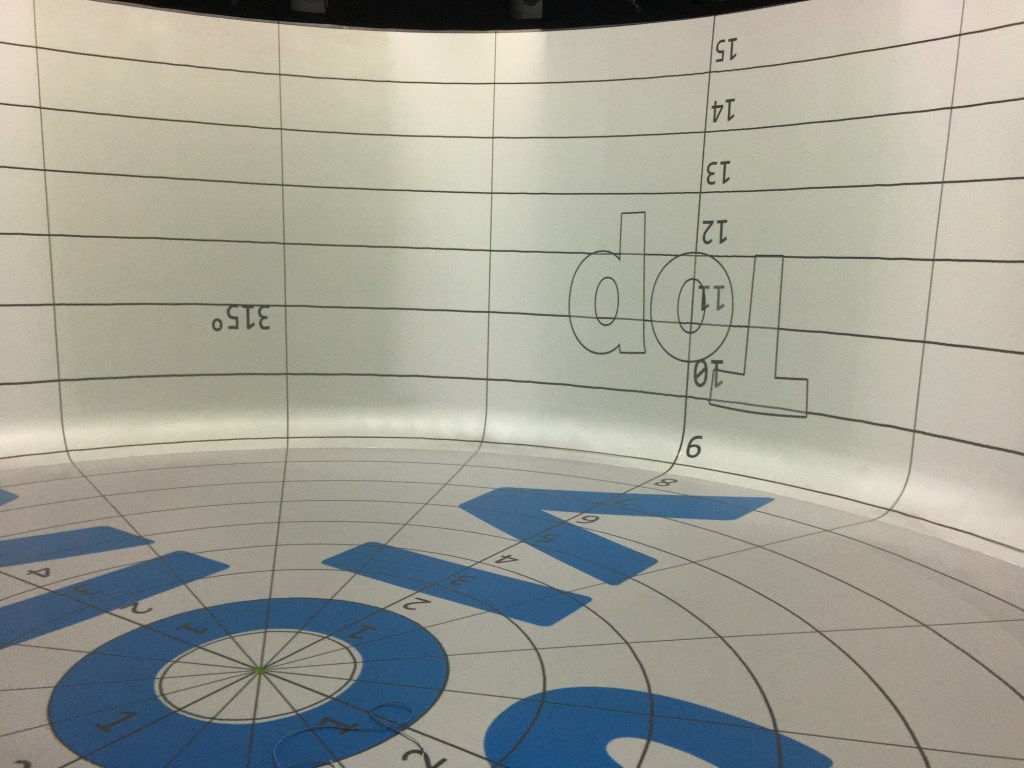
Here the operator intervenes and creates masks within the VIOSO system to prevent this happening. Small alignment shifts need to be corrected until finally the perfect, blended image with straight horizontal and vertical lines and a perfect edge cut-off is created (For reference, have a look at the uncalibrated projection).

This part of the project requires time and numerous re-calibrations, until the final data set can be saved and the integration in to programs like Watchout, can start.
To incorporate other programs, the calibration data is exported from VIOSO and then embedded into the target software which will adjust its graphic output according to the calibration data.
This capability of VIOSO, allows other systems, like Vertex, Pixera, Pandoras Box, Unity, Unreal, etc. to benefit from the VIOSO auto-calibration technology. (For more information, please refer to VIOSO).
Of course any project at this scale has sometimes other challenges, like vibrations at the projector level. In our case this could be traced to the floating installation of the projection space. Any strong movement outside the Cave would be transmitted through the floor to the wall and the projector rig. This of course created ‘swings’ at the camera and the projectors and made the process very difficult.
So some of the most critical work had to be done after the surrounding offices were vacated in the evening.

Since the project work went over a weekend, we took the opportunity for some time out. In the nearby forest was a red clay track, which was provided by a local brewery.
Walking barefoot on the clay, which stretched for a kilometre or more, should provide health benefits we were told. At least in late April it created cold feet.
But walking it was good fun, as it was to talk to the nearby peach growers and finding out why the peach trees were positioned at a 45 degree angle to each other?
As it turned out, it was for a very practical consideration. The peaches were easier to plug.
At this stage I also like to mention a most famous bakery in Daejeon. So famous that not only people come from long distances to buy bread, patisserie and other products there, but as early as 8am some items were already sold out.

In summary this was a most interesting project. We learned much more about the product were were selling and I am even more impressed by the VIOSO technology, the VIOSO founders and team and the perseverance by our Korean customers trying to provide a perfect project to their client.
Norbert Schmiedeberg
Manager and Consultant

